Give the power back to SEOs: Get your hands on the necessary tools and data
Heads up: if you’re not on the path to a C-Suite position as an SEO, it’s because you’re not data-oriented. We’ve seen why and how SEOs are positioned to succeed in companies; now we’ll look at how to put yourself on the right track by getting your hands on the data–and what to do with it to draw decision-makers over to your side for SEO projects.
Data is the difference between an SEO project you can get backing for, and an SEO project that sits in the drawer. This also makes it the difference between an SEO who is doing things and going places, and an SEO who may not be pulling their weight.
The trick behind a data-based strategy is that it requires data sources, and data processing power, whether in the form of tools, analysts, or both. SEOs sometimes have a hard time justifying the cost of data acquisition and analysis.
Let’s look at ways to get around those roadblocks as an SEO.
This article is the last of three articles discussing why we need to give the power back to SEOs, and how the strengths of a great SEO are central qualities for company success.
Read the previous articles:
Give the power back to SEOs: The path to the C-Suite
Give the power back to SEOs: Managing a broad and diverse team
SEO: low investment, high return
It wouldn’t make sense to invest in data if there was no indication of a return on that investment. In this case, though, SEO has been proven to be a highly effective inbound marketing strategy. This is true even though it can take longer than other marketing channels (such as paid search) to see results.
In fact, a New Media Campaigns study (2018) found that organic SEO is over five times more effective than paid search ads.
And Jumpshot’s recent (2018) analyses used by Rand Fishkin show that while the click distribution on Google’s search pages varies from country to country, organic results still pull approximately two-thirds of all clicks. This is far more than the 3-8% of clicks that go to paid results.
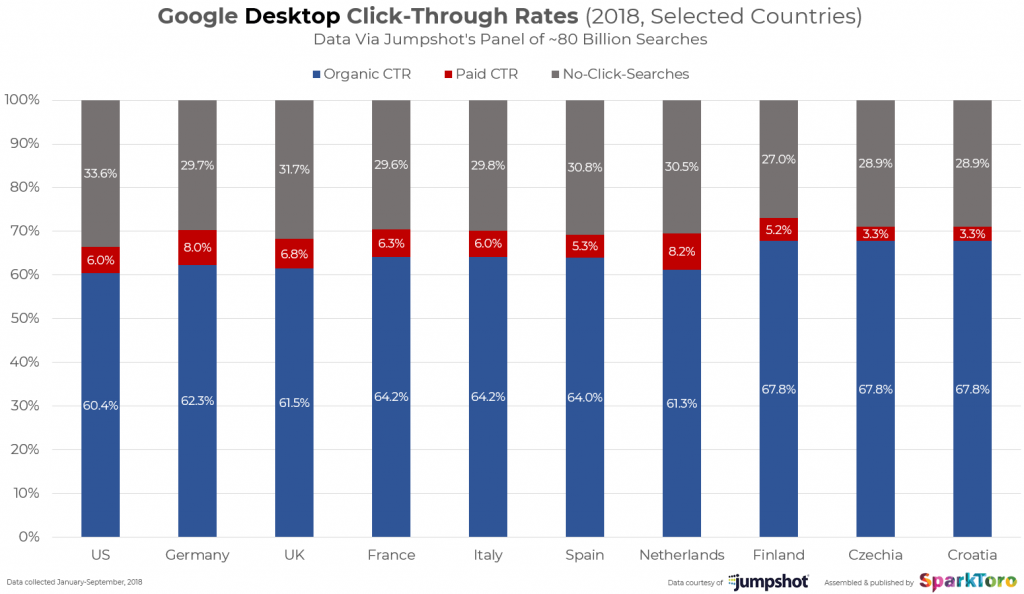
And we’re talking about percentages of a huge amount of traffic. In the US alone, Google currently processes over 9.5 billion queries per month; 60.4% of that is something like 5.7 billion clicks. And this is only on Google; there’s another 30% of clicks in the search market that aren’t accounted for in these figures:
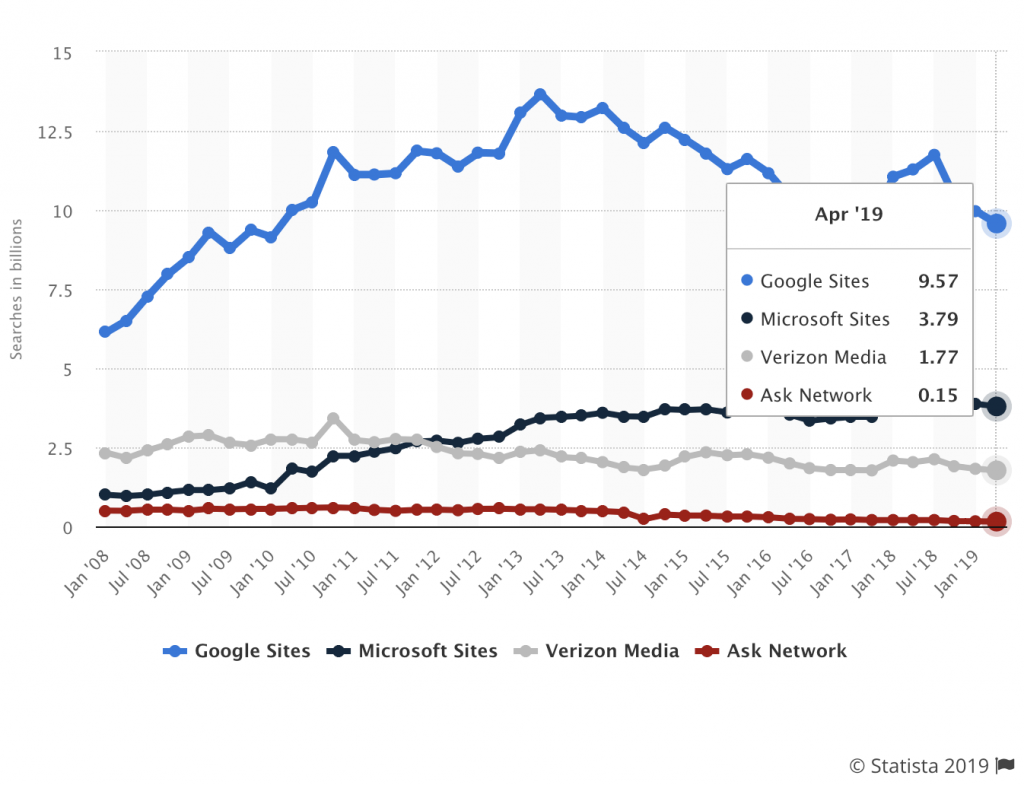
Number of explicit core search queries powered by search engines in the United States as of April 2019 (in billions) — Statista.com
Dominance of Google as a source of traffic
A website used as part of a business plan or marketing strategy cannot afford to ignore Google. Understanding how Google sees your site–and therefore how to earn rankings that will then increase the visibility of (and traffic to) your site–is the first step to accessing a gargantuan market.
Not only does Google provide more traffic than any other single source, but it also dominates the search market. Let’s unpack that.
- Biggest driver of website traffic: Analysis by Jumpshot analysts Stephen Kraus and Steve Levay, along with SEOs Rand Fishkin and Britney Muller determined that despite a decline in market share by an average of 8% since 2016, Google is “still the single biggest driver of traffic for the majority of domains.” In other words, underperforming SEO can affect a significant portion of your website traffic–more than any backlink, and more than any one social network.
- Largest search market share: Google and Google-owned properties (Google Images, Google Maps, YouTube…) make up over 93% of US searches, or over 96% of European searches. With the exception of certain niches, concentrating on Google will cover almost all of your SEO traffic.

[oc-redirect num=1]
Cost of tools vs cost of manual analysis
Just as this argument in favor of SEO is more powerful with numbers to back it up, the arguments developed by SEOs are stronger when based on data. Data-based decision-making limits a project’s risk by offering realistic projections, costs, and gains.
SEO data tools make the work of an SEO much easier and more efficient. They simplify and improve on the following SEO processes:
- Collecting SEO data, through the use of crawlers and APIs
- Storing and accessing SEO data, though the use of data platforms
- Analyzing and aggregating SEO data, through algorithms and automation
- Presenting results from SEO data, through the creation of charts, graphics, and reports
Although the cost of a data platform is hard to justify as a project expense, it shouldn’t be. Imagine a website audit:
| Without a tool | With a tool | |
|---|---|---|
| Link functionality | Comb individual pages or wait for reports of broken links | Open a report |
| Website structure | Compute the number of links to each page by hand, as well as the shortest path from the homepage | Open a report |
| Page titles, meta descriptions, and headings | Create an Excel document and paste elements from each page | Open a report |
| Page status codes | Test individual pages manually and record the results | Open a report |
| Backlinks | Comb through Google Analytics referring sources for the past months | Open a report |
And so on, extending to even more complex tasks like identifying duplicate content, or trying to measure the connection between website depth and number of organic sessions.
When you compare the time you would spend compiling the data and analyzing it by hand, even expensive tools cost less than paying an SEO to pick over a site by hand.
Justify actions by measuring ROI
The point of an SEO tool, on a business level, is not simply to make an SEO more efficient on a given project. The reason for a tool is to provide the ability to measure, arbitrate, and prioritize projects. With an SEO tool, it is possible to make predictions about the cost and the outcome of projects and to measure the expected and the attained ROI.
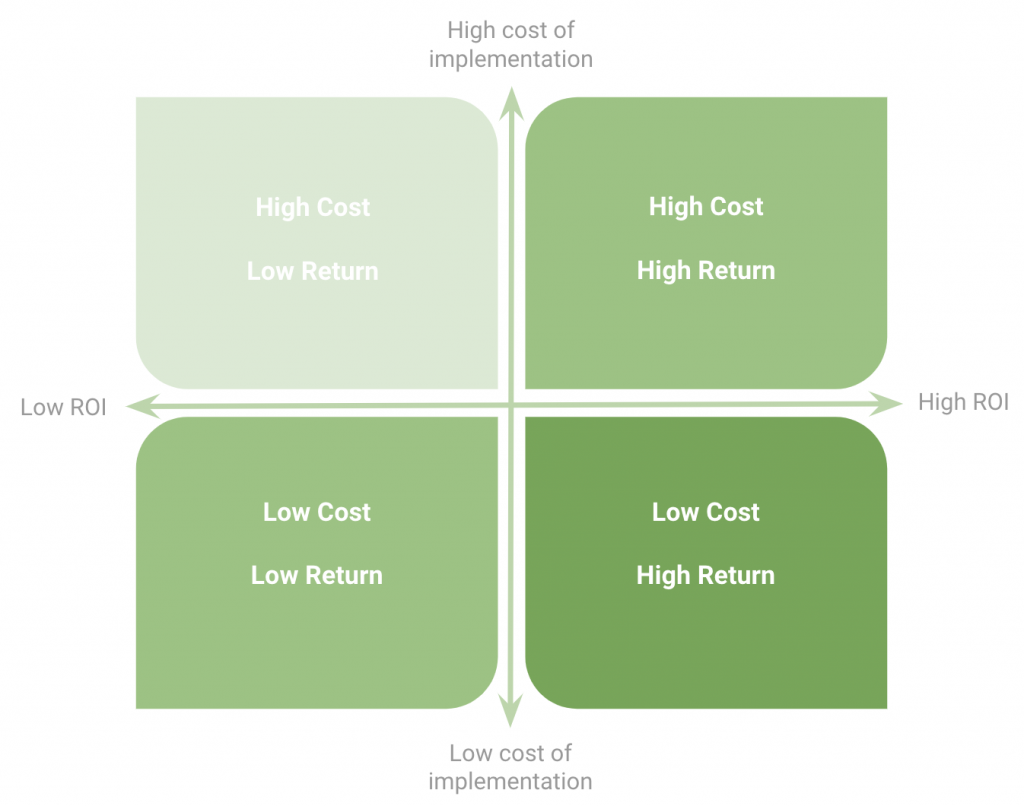
To identify high return, use tools to help you look for:
- Metrics that have a strong, demonstrated correlation with rankings, clicks, and conversions

Slow-loading pages have fewer visits (Oncrawl)
 The top 10% of pages by number of impressions are rarely found in depth 5+, but over 75% of the website’s pages are found at this level (Oncrawl)
 - Metrics Google evaluates when ranking a site, for which your site performs poorly
 Duplicate or missing titles, descriptions and H1s (Oncrawl)
Slow page load time is a known Google ranking factor, as well as a UX problem (Oncrawl)
Cost estimations will depend on many things, including:
- The available SEO skills and resources. For example, the technical SEO who is at ease with web development may take a few hours to implement fixes that might otherwise require a long process of education and crying for development resources.
- Your website’s platform and structure. On legacy platforms, what would be a simple fix in a recent WordPress CSM might have unforeseen impacts, or it might be nearly impossible to deploy in a stable environment.
Data also demonstrates the results achieved through SEO efforts. When you can show the results of your work have produced more Googlebot hits, followed by increased impressions, followed by increased click-through rates, and finally increased conversions, you can make your voice heard in discussions on marketing and business strategy.
How your company profits
By using data platforms to guide your SEO efforts and to measure their results, you can build an SEO strategy that is effective and efficient as an inbound marketing tool. Understanding how your company’s website functions, how Google sees it, and how to use these two elements to drive marketing and sales efforts are the best contributions an SEO can make.
Using data-based argumentation, SEOs can not only demonstrate the skills that make SEO a powerhouse for business development, but also show that they understand company risks and resources. Building low-risk project proposals, ensuring ROI, and communicating value through numbers all require SEOs to take a data-oriented approach–and demonstrate the value of SEO as a keystone piece in successful companies.