Give the power back to SEOs: Managing a broad and diverse team
The qualities that make someone a good SEO also make them a great company resource. Good SEOs must have or acquire the skills needed by high-level team management and project-oriented decision-making positions. Even when there is no dedicated SEO team in place, an SEO project draws on collaborators with varied skills and backgrounds in radically different domains.
This ability to manage a project with diverse contributors is not only required for successful SEO, but also an extremely valuable asset for the company itself.
This article is the second of three discussing why we need to give the power back to SEOs, and how the strengths of a great SEO are central qualities for company success.
Read the first article: Give the power back to SEOs: The path to the C-Suite
Read the next article: Give the power back to SEOs: Get your hands on the necessary tools and data
We’d like to thank our contributor whose willingness to share his experience has made this article possible:
Murat Yatağan, Vice President of Growth at Brainly
Murat has more than 9 years of SEO and UX expertise, of which 5 years derive from his role as Senior Product Analyst at Google Search Quality Team (now Trust & Safety) in Ireland. During his consultancy career he built significant experience in technical SEO, high-quality content creation strategy, outreach, and international SEO. He has managed SEO teams for key players in different market niches and maintained a portfolio of 65+ clients globally from various business verticals.
Making a place for SEO within a company
The varied faces of SEO–from marketing strategy to content creation, sales support, growth hacking, outreach, communication, and web development–often make it difficult to place within an organization.
Depending on the tasks carried out in-house, SEO may have been integrated into one of many different departments:
- Marketing or Communication
- Sales or Pre-Sales
- Growth
- Web development or IT services
There may even be historical reasons for SEO to be assimilated with a given department, even if the current SEO tasks have little to do with the larger department objectives.
In part due to this mismatch, building and managing an SEO team requires the ability to work within very different types of contexts and to arbitrate resource allocation between department and SEO objectives.
SEO covers many domains requiring varied skills
When a single SEO is in charge of in-house SEO, the many hats they wear make them an expert in fields that, individually, provide incontestable value to the company.
Most SEO teams, whether they’re composed of a single SEO or of ten team members, have a need for the following fields, which are often not covered by other departments within the organization:
- Analytics and data analysis
- Content marketing
- PR, communication, linking and outreach
- Development and technical SEO
- Growth hacking
When these fields are not fully covered by other departments in the organization, SEO becomes responsible for providing the entire company with usable results in each of these areas, in addition to SEO. And when other departments for these fields do exist, they may not cover SEO projects without the SEO negotiating for resources on a project-by-project basis.
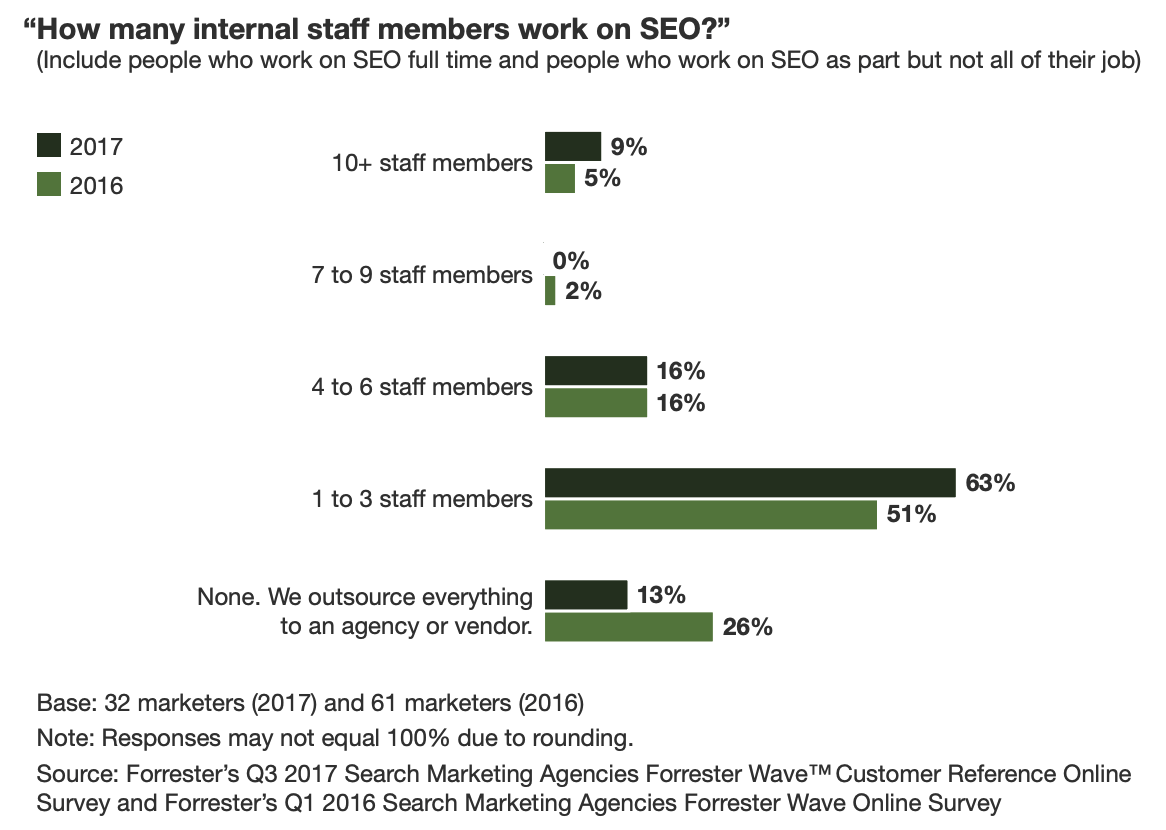
Ideally, an SEO team should be able to draw on dedicated resources in all of these fields. And in-house teams are growing, as determined by Forrester’s 2018 report:
The ideal SEO team
A strong SEO team is by nature diverse, involving many different workflows and different approaches to the job drawn from each of the various fields.
Murat Yatağan, Vice President of Growth at Brainly, describes his ideal SEO team as follows:
- SEO Director: manages strategy and directs the team. The director negotiates resources and arbitrates projects at an enterprise level.
- BI Analyst and, if possible, an SEO Data Analyst: in charge of KPI tracking, forecasting. They allow the team to rely on data.
- Technical SEO: if site is big enough, the technical SEO is in charge of making sure that the website is optimized (HTML, CSS, JS…), of setting up crawls, and keeping track of the importance of new product changes for SaaS and web technology products
- SEO Content Manager and Content Team: in charge of content policy, policy enforcement and content creation.
- Outreach Manager and Outreach Team: in charge of tracking pitching, outreach channels, and organic link acquisition.
- SEO Product Team:
- Product Owner: responsible for the SEO roadmap, and for making sure that the right knowledge is shared with the right people.
- Engineer Manager and SEO Engineers: in charge of technical execution and innovation. Specialized engineers with knowledge and experience on SEO projects provide massive value; the SEO team shouldn’t have to “rent” engineers from the IT department.
Murat’s advice for building the ideal team comes from his experience in SEO in fast-paced startups:
- Find people with ambition and match them to the job. For the team to run smoothly, individual team members must own workflows that contribute to team goals.
- Expect and plan for personal and career growth in team members, particularly in young companies. For example, when hiring the first outreach person, look for someone capable of making a transition to manager as the team grows. Things can change fast.
- Don’t look for expertise or experience. This comes from training and time on the job. You’ll get better results by recruiting people who care, who learn, and who attack challenges in their free time.
It’s obvious looking at this advice that it isn’t specific to SEO. Like many practical in-house SEO skills, team structure and team-building skills in SEO are valuable to a company precisely because they translate well in a larger context.
[oc-redirect num=1]
A great leader: team management skills built on SEO skills
If the skills needed to be a good team leader to such a diverse team are principally the same skillset you’d look for in any quality manager, Murat adds that his varied SEO background helped prepare him for the job:
The variety in my career has been really helpful. I’ve been a researcher, a Google Analyst–which in reality involved some mentoring–, a freelancer, and a company owner. Working with different people and different clients has made me better able to match business needs to my own knowledge and has made me a lot more adaptable as a leader.
— Murat Yatağan
The hands-on skills and the breadth of competences acquired as a one-man team also help SEOs know how to delegate, and why delegation is important.
How your company profits
SEO is still searching for its place within a company. Sometimes part of the IT department, sometimes a subset of the marketing department, SEO teams of any size are responsible for activities covering a broad range of fields.
Bringing together the right people, with the drive to succeed, the ability to work on SEO projects, and functional, expert knowledge of each of the different fields, is a job in and of itself. Those best-suited for it are SEOs themselves: people who have hands-on knowledge of what needs to be done, who are used to straddling roles, who can adapt with diversity, and who understand first-hand why (and what) to delegate.
This is what makes SEOs the high-performing, high-level managers of tomorrow.