Another edition of BrightonSEO has come and gone and true to form, the go-to event for search marketers did not disappoint.
This was only the second edition of Brighton I’ve attended (which means I’m still a newbie), but I found that this year’s conference put special focus on AI’s growing influence, the importance of evolving your content strategy, and how the processes we know as search and discovery are quickly changing.
For anyone who has attended BrightonSEO, you are well aware that with so many parallel sessions, it’s difficult to choose which ones to attend! But choose you must.
As such, below is the round-up of interesting presentations and takeaways that caught my attention over the two-day event.
AI’s evolving role in search
There’s no escaping it, AI is very much integrated in search. A number of conferences explored the relationship between traditional search and AI tools at Brighton this year.
Josh Blyskal – We analyzed 10,000,000 AI search results: here’s what we found
Quick summary
Josh Blyskal presented some compelling insights he gathered after analyzing millions of AI search results. His findings revealed surprisingly little overlap between AI search results and traditional search engines, suggesting that SEO professionals need distinct strategies for each.
The data showed that different AI tools have different preferences for sources – with ChatGPT favoring Wikipedia, Perplexity preferring UGC (user-generated content), and Copilot looking to Forbes.

Key takeaways
- Only 12% of ChatGPT results overlap with Google SERPs.
- ChatGPT’s overlap with Bing is just 26%, despite using Bing’s API.
- If you’re not indexed by Bing, you’ll never appear in ChatGPT responses.
- AI search tools show a strong preference (32%) for listicles and comparative content.
Veronika Höller – Beyond Google: redefining SEO for AI-powered tools
Quick summary
With ChatGPT’s number of weekly users reaching 400 million, Veronika Höller explored how AI tools are changing search behavior.
Her presentation focused on the difference between traditional SEO and AI-SEO and what we should be doing to optimize content for both AI tools as well as traditional search engines.
She emphasized that user behavior is changing and for those seeking precise answers, they are nowadays more likely to turn to AI tools.
Key takeaways
- AI optimization requires concise, clear answers.
- Fresh, regularly updated content is more relevant for AI tools.
- Test your content to make sure it’s compatible with AI tools.
- Audit whether AI tools reference your brand; if not, analyze the sources they do use.
If you’re interested in reading more, you can check out her full presentation.
A focus on content strategy
While Brighton may be well known for technical SEO focused presentations, as a content marketer, I was pleasantly surprised to find that several speakers shared insights on creating more effective, targeted content strategies.
Carl Poxon – Using content clusters for human-centric conversions
Quick summary
Carl Poxon revisited the concept of content clusters, focusing not on their structure (which he noted “aren’t new”) but on the challenges associated with implementation.
He emphasized that the biggest obstacle to successful content clusters isn’t technical knowledge but getting organizational buy-in and stakeholder involvement.
His human-centered approach prioritizes user needs in addition to keyword targeting.
Key takeaways
- Involve the right stakeholders from the start and ensure everyone takes ownership in content strategies.
- Content should align with user intent, going beyond the traditional types of search intent (i.e. navigational, informational, commercial, and transactional).
- Structure content based on both search intent and user needs, not just keywords.
- User personas are more important than demographics when planning content clusters.
Oluwatobi Folasade Balogun – Maximizing content efficiency with minimal environmental impact
Quick summary
Oluwatobi Folasade Balogun delivered a unique talk on sustainable SEO practices, highlighting the environmental impact of excessive content production.
Emphasizing that, “over 90% of all published content gets zero organic traffic from Google,” she made a compelling case for more strategic, efficient content creation.
Her approach focuses on quality over quantity; addressing genuine audience needs while minimizing digital waste.

Key takeaways
- 60% of Google searches in the EU end without a click, suggesting we’ve reached a point of content oversaturation.
- We should focus on creating content that serves a real audience need.
- When we do need to create content, it’s important to make it fast, lean, and easy to consume.
- When possible, refresh, repurpose, and reuse content.
Oluwatobi has shared her full presentation if you’re interested in learning more.
Sarah Pokorna – Mindset based targeting: achieving 5x more with 5x less
Quick summary
During her talk, Sarah Pokorna challenged the use of traditional demographic targeting in our marketing practices. She instead advocated for the use of a psychological approach that takes into account whether consumers have a fixed or growth mindset.
Sarah explained that understanding user psychology leads to more effective messaging and better conversion rates.
Key takeaways
- Demographics are less effective for targeting than psychographics and mindsets.
- Fixed mindset consumers are more susceptible to brand loyalty, status messaging, speed and results.
- Growth mindset consumers focus on learning and personal development.
- For fixed mindset audiences: your marketing should focus on ease of use, performance goals, and the image your product conveys.
- For growth mindset audiences: your marketing should emphasize learning opportunities and the quality of a product.
Check out her presentation slides on LinkedIn.

Social search and influencer marketing
I wouldn’t go as far to say that traditional text queries in Google are a thing of the past, but with voice search, visual content, and AI-powered tools creating new opportunities for brands to connect with audiences, it is no longer dominating our search patterns as much as it did before.
As users increasingly turn to platforms like TikTok, Instagram, and Pinterest for product discovery, optimizing for these alternative search environments is becoming more important.
Several speakers at Brighton highlighted how these changes are reshaping SEO strategies.
Ashley Liddell – How social search is shaping discoverability
Quick summary
Ashley Liddell spoke about the evolution of search behavior, arguing that “search is no longer a platform, but now a behavior.”
He explained how Google’s increasing complexity is creating friction for users, pushing them toward social platforms where discovering information has become easier.
Ashley also demonstrated how social search now touches multiple stages of the customer journey.
Key takeaways
- Social search provides users with solutions when traditional search creates friction.
- Search marketing is becoming democratized across platforms.
- Community engagement drives social search effectiveness.
- Social search can impact every stage from brand discovery to purchase.
- Social platforms create more personalized search experiences than traditional engines.
Alex Ighalo – Data-driven influencer marketing for unsexy brands
Quick summary
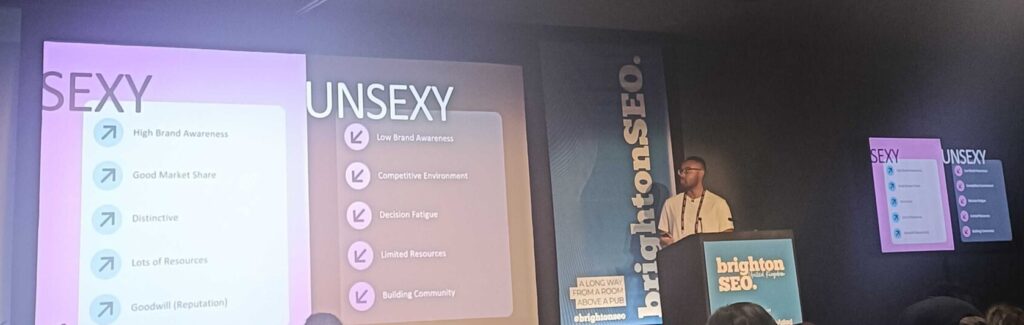
Alex Ighalo walked us through the challenges faced by “unsexy brands” in competitive markets with limited resources.
First, he explained the difference between sexy brands (those with high awareness, good market share, and ample resources) and unsexy brands (those dealing with low awareness, fierce competition, and limited budgets).
Alex then showed us how leveraging data analytics and AI tools can help these brands compete effectively in the influencer marketing space. His practical approach focused on using AI to solve specific problems these brands face rather than trying to match the spending power of larger competitors.
Key takeaways
- You should use competitor data analysis to inform your influencer marketing strategy and identify opportunities.
- Combat decision fatigue by using analytics to narrow your options and focus resources.
- Leverage AI tools for certain tasks (like creating initial campaign briefs) and focus human resources on higher-value tasks AI can’t handle (such as relationship building and creative direction).
Ray Saddiq – How multi-channel content captures intent & EEAT signals to drive growth
Quick summary
Ray Saddiq spoke about creating an effective multi-channel content strategy. He explained that it goes beyond your own website, it should incorporate various platforms to build both brand visibility and strengthen E-E-A-T signals.
The strategy he implements leverages subject matter experts across multiple channels to create a network of content that reinforces brand authority.
Key takeaways
- When brands struggle with growth, they must determine if they face a demand problem or a discovery problem.
- Let actual experts tell your story to build genuine experience signals; these voices carry more weight than brand-created content.
- A comprehensive multi-channel strategy should include forums, industry publications, and short-form videos.
- Off-site signals are crucial for boosting visibility and establishing E-E-A-T.
Wrapping up
That’s a wrap for the April 2025 edition of BrightonSEO!
The overarching idea that continued to resurface during the conference is that successful SEO requires a more holistic view that incorporates technical knowledge, psychology, content expertise, and an understanding of multiple platforms—all while being mindful of AI’s growing influence.
It’s becoming more important to balance optimization for both traditional search engines and emerging AI platforms.
We’ve only scratched the surface of the insights shared across the two days. Let us know what your favorite sessions or key takeaways were.
See you in October!